
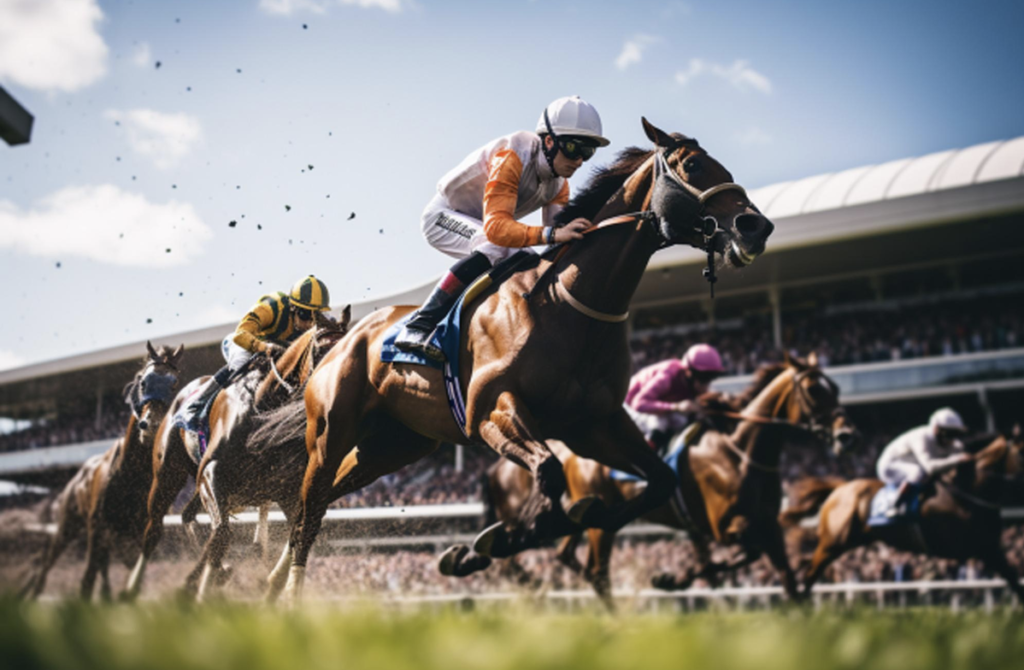
 Two furlongs out, the commentator says the favourite is still on the bridle, and the price on that horse starts shrinking before most viewers have taken it in. Live betting gets its own slot in the main menu of many bookmakers, the Arabic version of الموقع الرسمي لـ BizBet included, and in horse racing those live markets move about as fast as the commentator can talk. That makes the stock phrases worth learning, along with what each one means for a bet that’s still live.
Why Your Screen Is Behind the Race
How far behind are you, sitting at home? A TV broadcast of a race can run five to seven seconds behind the course, a stream twelve to fifteen, and a weak mobile signal adds more on top. Every broadcaster’s lag is slightly different, too. In a race lasting a few minutes, that’s plenty of time for the market to move without you. Exchange prices can drop from 5.0 to 2.0 in roughly two seconds once a horse takes the lead at the head of the straight, and anyone watching on course or through drone pictures sees it first. Bookmakers add a short delay of their own to in-play bets as well, usually a few seconds in racing.
1. On the Bridle and Travelling Well
“Still on the bridle” means the horse is moving comfortably and the jockey hasn’t had to ask for anything extra. Commentators often swap it for travelling well, and a horse doing either isn’t overracing. In-running prices follow each runner’s position and momentum, so a horse cruising at the two-furlong marker while the others are being niggled along tends to see its price come in as theirs drift out.
2. When a Horse Comes Off the Bridle
The moment a jockey starts pushing along and asking for effort, the horse is off the bridle. In the first part of a race, that can mean trouble. Not always, mind you. Some horses are known for running lazily until they’re asked and then finding more, and a pushed along on one of those can fool anyone betting on the commentary alone.
It means more for a leader. A horse that made the running has led and set the pace for all or most of the race, and if it comes off the bridle as the field turns for home, its backers are hearing a warning sign at the stage that matters most.
3. Keen, or Pulling for Its Head
In the early stages you’ll often hear that a horse is keen, or pulling for its head, and some commentators call it running too freely. The horse wants to go faster than its jockey is allowing. Racing that way burns energy needed for the finish, and keen runners often weaken in the closing stages as a result.
4. Phrases About Traffic in the Field
Plenty of commentary is about the space around a horse rather than the horse itself.
- Missed the kick (also slowly away), meaning the horse lost ground as the stalls opened.
- Boxed in. Runners on every side and nowhere to go.
- Held up for a clear run, where the jockey waits for a gap that doesn’t open in time.
- Checked, when the jockey has to slow the horse sharply to avoid the runner in front.
Checking can cost a horse lengths.
5. One-Paced When the Tempo Lifts
If the commentator calls a horse one-paced, it’s keeping up the same speed but can’t quicken when the tempo of the race rises. In practice that often means it holds its position without threatening the leaders. Late on, the word is worth noticing if you’re weighing up a place bet, since a one-paced horse may stay in the frame and still never look like winning.
6. Staying On and Making Headway Late
These three belong to the closing stages. Staying on describes a horse finishing strongly, running on is used in much the same way wherever the horse ends up, and made headway means a horse has gained ground on the field in the latter part of the race. By the time any of them is said, the line is close, so there’s little time to act in running.
What Today’s Commentary Says About the Next Race
After the race, the comments go into the form book, printed under each past run, and they fill in what the finishing positions leave out. A horse that ran keen last time may improve in a stronger-run race or with different tactics. One that was held up for a clear run might have deserved a better result than the bare figures show. Bet only with money set aside for racing, and only if you’re 18 or over.